Ambient Contrast Analyser
A web tool that estimates how readable text on an LCD screen is under different ambient light. It extends the WCAG contrast check, which ignores the device and the lighting.
Why
The WCAG contrast ratio, which tools such as the Colour Contrast Analyser compute, uses only the two colours. It ignores the device and the lighting. Outdoors, a screen's reflectance, peak brightness and black level change how much contrast you actually see, so a text that passes on paper can fail in sunlight.
The study
Working with the Norwegian Colour and Visual Computing Laboratory, I ran an experiment for the course Colour in Interface Design (IMT4315, NTNU). It measured character recognition on LCD screens under simulated ambient light, from an office (about 500 lux) to a cloudy day (about 5,000 lux). The model is fitted to data up to an ambient contrast ratio of about 6:1, so it becomes unreliable above roughly 10:1.
The model
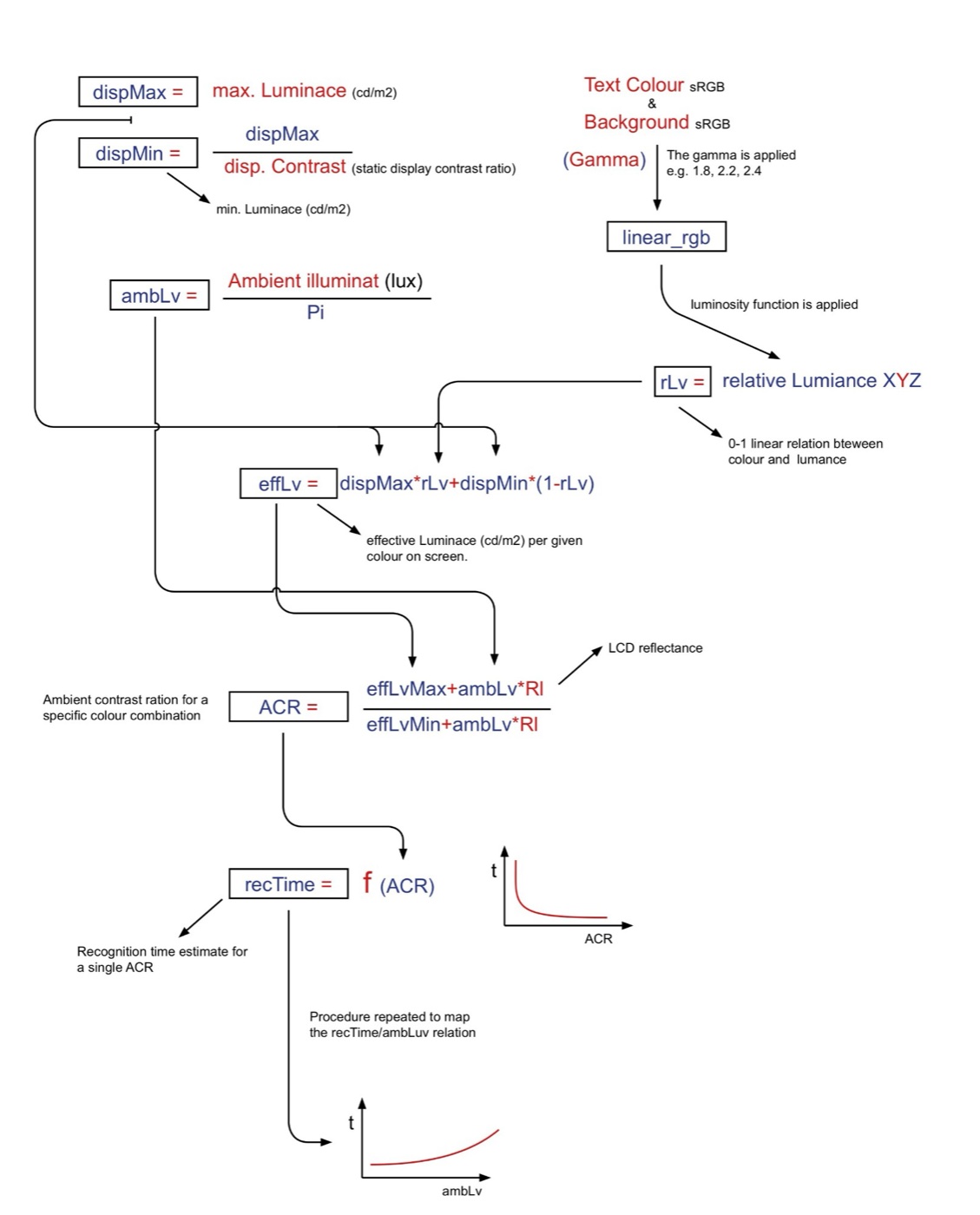
- The text and background colours are converted from sRGB to linear light, then to relative luminance.
- Relative luminance is mapped to the light the display actually emits, between its black level and its white level.
- Ambient light is added to both levels, weighted by the screen's reflectance. This gives an ambient contrast ratio for the colour pair.
- The contrast ratio gives an estimated recognition time for a standard test: four random characters at 24 arc-minutes, which takes about 800 ms for a good reading.
Recognition time falls as contrast rises and grows as ambient light increases. A result well above 800 ms means readability has dropped.
The web tool
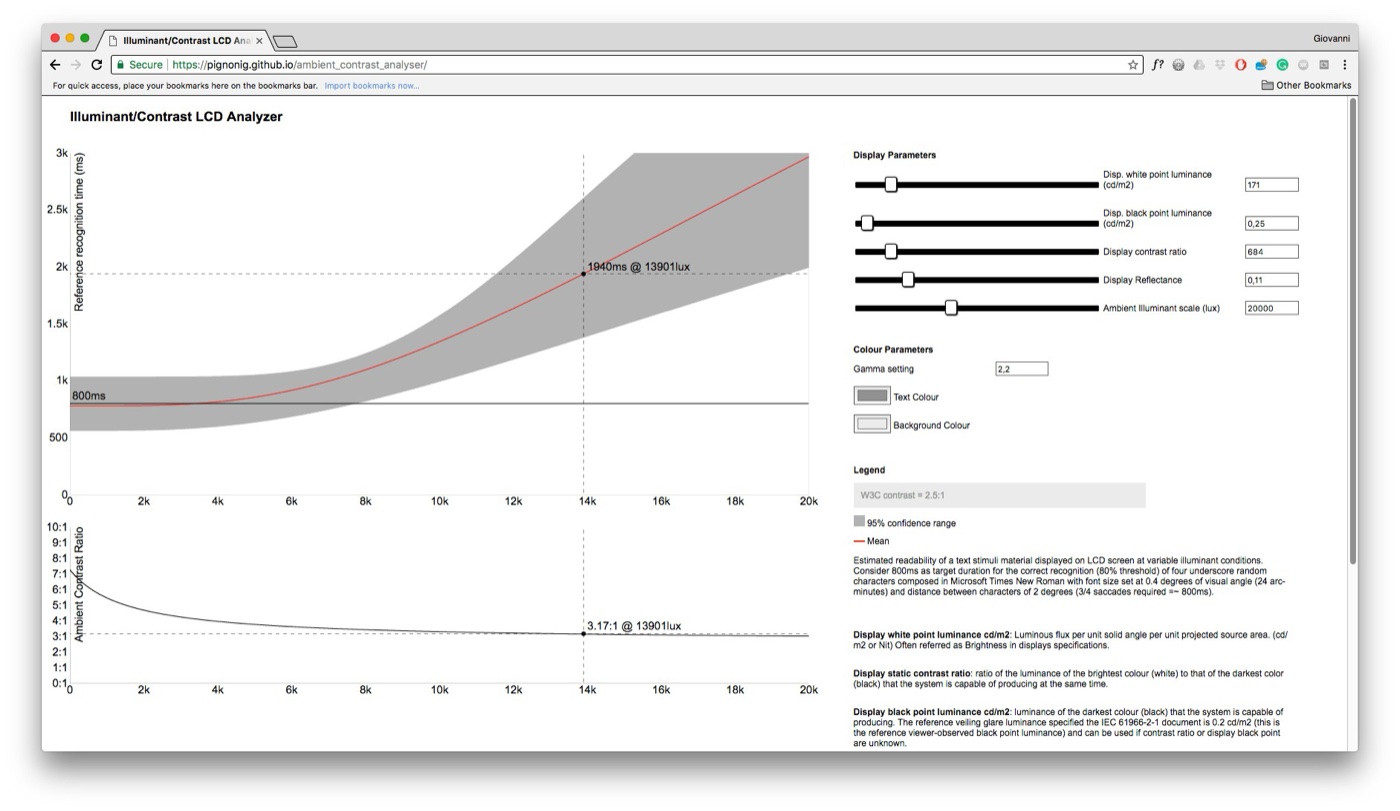
You enter a display's white and black luminance, contrast ratio, reflectance and ambient light, plus a gamma value. The tool plots the expected recognition time against ambient illuminance, with a 95% confidence band, and shows the ambient contrast ratio. A reference table of phones, tablets and watches supplies typical values, drawn from published Displaymate measurements.
The tool is not yet a reliable colour-evaluation tool. Further work would need to cover contrast above 5:1 and more variables, such as character size and visual acuity.
Links
- Live tool: pignonig.github.io/ambient_contrast_analyser
- Source code (MIT licence): github.com/pignoniG/ambient_contrast_analyser
Thanks to Peter Nussbaum and Philip John Green for help with the experiment and technical supervision.