PA88 High-Voltage Amplifier
A ×20 DC-coupled amplifier built around the Apex PA88 that turns the ±10 V of my HP 3245A into about ±200 V. A precision op amp in the loop corrects its offset, so it can be used for calibration work, not only as a power stage.
Goal
My HP 3245A universal source stops at ±10 V. HP sold a high-voltage option (a ×10 amplifier based on the Apex PB58), but my unit doesn't have it. I wanted a way to produce stable, known voltages up to about ±200 V, so I could check the high-voltage ranges of my meters together with my precision 1:10 divider.
I chose the Apex PA88 hybrid op amp. It tolerates a higher supply voltage than the PB58, at the cost of being slower and less powerful. For DC and low-frequency calibration work, that's the right trade.

Approach
- Gain of 20. With the 3245A supplying ±10 V, the output reaches a bit over ±200 V. The amplifier is non-inverting, so the input impedance stays high and +10 V in gives +200 V out.
- Stable gain resistors. The gain is set with precision thin-film resistors plus a trimmer. In the feedback path, a string of resistors in series takes the full output voltage, so the power and voltage stress on each part stays low. My first version drifted at high output because of self-heating in the feedback resistors. Spreading the dissipation over more resistors fixed it.
- Offset correction. On its own, the PA88 showed 2–3 mV of offset at the output with the input shorted. In the second version I made it a composite amplifier: an LT1012 precision op amp corrects the PA88's DC errors, with a front-panel trimmer to null the remaining offset.
- Protection. The PA88 has a built-in current limit, and the board adds TVS and clamp diodes.
- Floating or grounded. A front-panel switch connects the input common to ground or lets it float (up to 42 V peak), so I can deal with ground loops depending on the setup.
Implementation
The high-voltage supply is based on a design by changpuak.ch. It uses two A41-25-230L transformers and gives about ±212 V, with a current limit of roughly 60 mA. The transformers can be wired for 115 V or 230 V input. I wired them in reverse relative to the marking, to get a slightly lower voltage into the supply and stay away from the limit of the 400 V capacitors.
The PA88 sits on a small heatsink on the amplifier board. The case is a finned aluminium enclosure, with a fan on the lid.
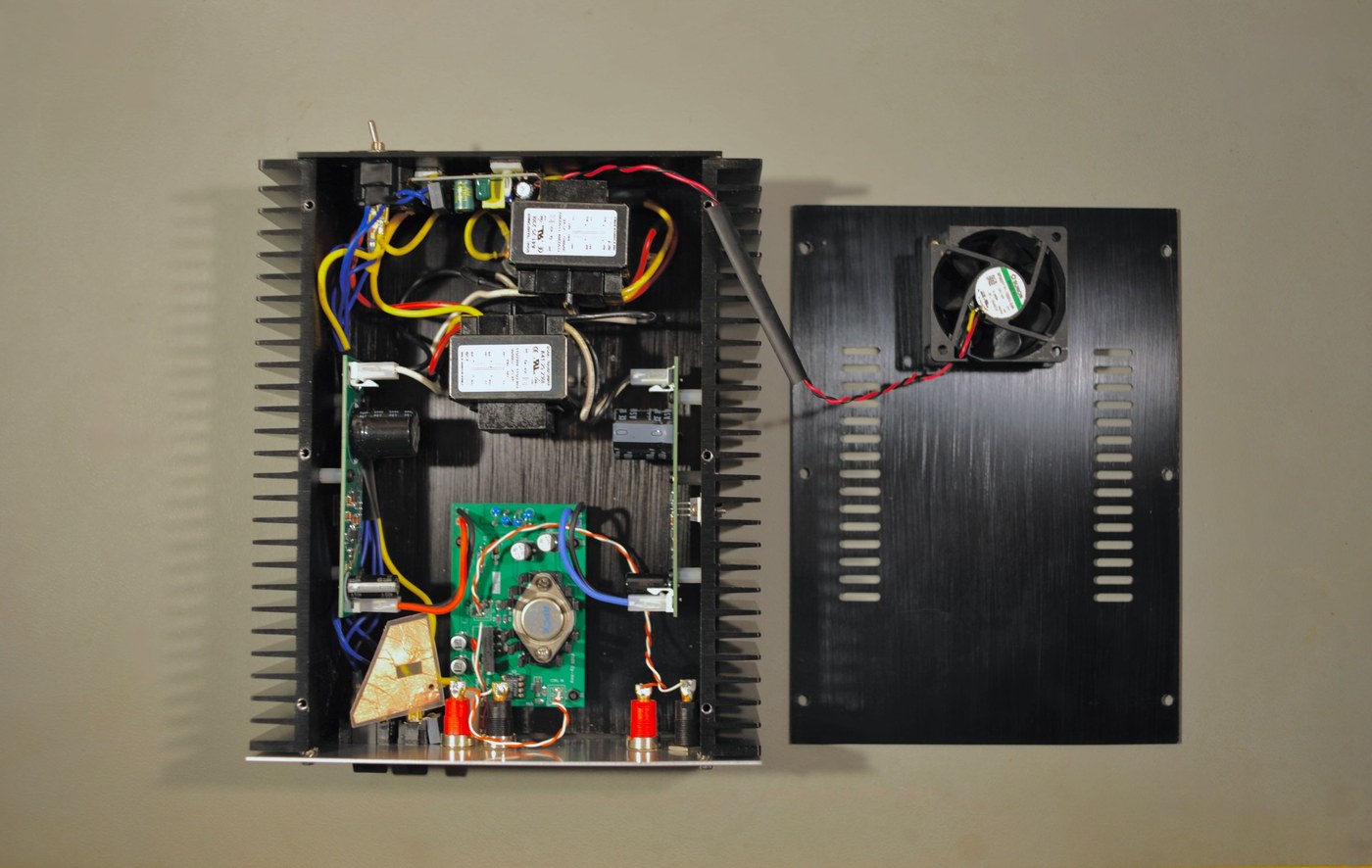
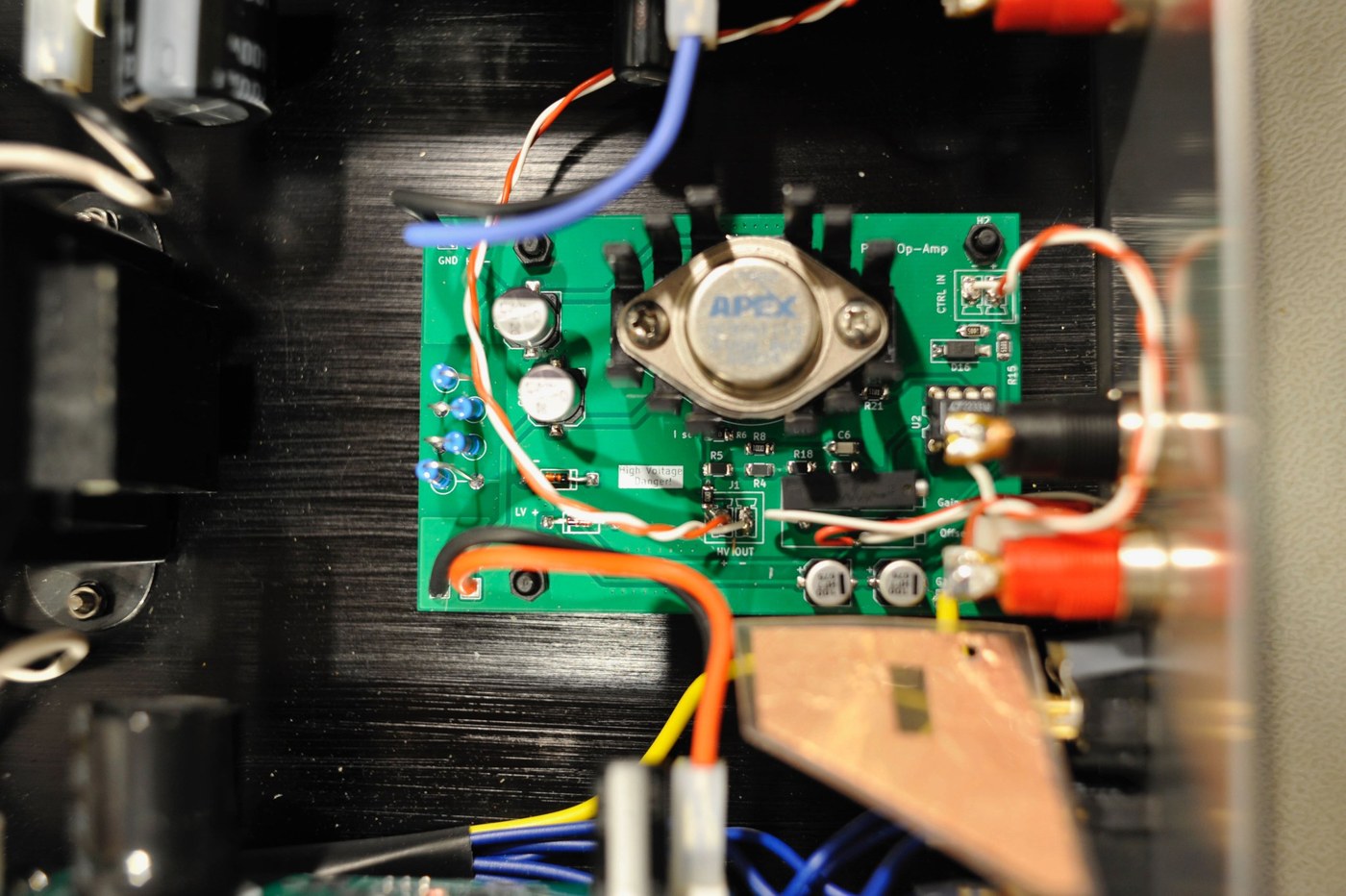
Interactive view of the composite amplifier board: drag to pan, scroll to zoom, click a part to select it.
The schematics, PCBs and Gerbers for the supply, the first amplifier and the composite amplifier are all in the repository.
Results and status
- DC: with the composite version, gain and offset are very stable. I saw no self-heating effect even at high output voltage. The offset can be nulled to about 0.1 mV at the output.
- Noise: low enough that, when measuring with the 3245A, its own ADC dominates.
- AC: an accurate 100 V RMS at 1 kHz. The bandwidth at full amplitude is only a few kHz, limited by slew rate and by the compensation the composite loop needs to stay stable. So the "100 kHz" printed on the front panel is optimistic. That figure only applies at small amplitudes.
- Capacitive loads: they showed some ringing. The last revision of the board changes the compensation to improve stability. [TODO: results after the stability revision]
In my setup, the amplifier drives the 1:10 divider I use to check my HP 3456A's 100 V range.
Links
- EEVblog forum thread: design discussion, measurements and plots
- Source on GitHub: KiCad projects, Gerbers and BOMs for the supply, the amplifier and the composite amplifier [TODO: licence]
- Composite amplifier schematic in KiCanvas